
Raiven & ESG in 2022
As the United Nations General Assembly (UNGA) debates opens in New York City with the theme of “A Watershed Moment,” the world faces unprecedented and interconnected crises: a tipping point for climate change, the global pandemic, war in Ukraine, and runaway inflation.
Despite these seemingly intractable problems, the UN argues that there are transformative solutions to these crises. We wholeheartedly agree. As investors, it is our job – a critical one – to seek innovations that solve real-world problems, especially in terms of environmental, social and governance (ESG) goals. Several of our investments actively tackle issues that are high on the agenda of the UN’s Sustainable Development Goals.
With this in mind, it is timely that we give a progress report in this mid-investment period: much of it exceeds our expectations, especially within ESG. As a firm, we actively support women. Four out of eight of our venture partners are women, and several of our companies are female-founded and led: Scopio, Whizmo and Vertical Harvest.
A few high notes on our investments:
Vertical Harvest (Jackson, Wyoming)
Vertical Harvest actively works to promote sustainable agriculture that is local, and uses 90 percent less water and land. Consider the negative environmental impact of industrial agriculture and how climate change is impacting agricultural prices, and it is clear why farm efficiency is needed. Vertical Harvest’s urban vertical farms use AI and IoT to improve yields and build smarter cities in locations across the US, starting with its first farm in Jackson, Wyoming and planned expansion across the US. A whopping 100,000 pounds of produce are produced per year from only a tenth-of-an-acre plot of land and its employment scheme provides a model for the industry, as Vertical Harvest’s staff consists of 40% neurodiverse employees. The company was recently profiled on CBS This Morning, and was nominated by Fast Company as one of the Best Workplaces for Innovators.
Elevated Signals (Vancouver)
Elevated Signals is an AI-driven enterprise software platform that radically streamlines controlled environment agriculture (CEA) operations from seed to sale, increasing the environmental impact of CEA companies. Consider the impact better connectivity has on agriculture: a McKinsey report which chronicles the ways improvements in technology can yield massive agricultural growth: “Artificial intelligence, analytics, connected sensors, and other emerging technologies could further increase yields, improve the efficiency of water and other inputs, and build sustainability.” The report also states that greater connectivity would yield $500 billion in additional value in terms of global gross domestic product by 2030, creating efficiencies that would alleviate pressure on farmers.
WayOut (Stockholm, Sweden)
Wayout is an IoT enabled water purification technology system that fits within a shipping container, can be rapidly deployed almost anywhere on Earth and provides 3,000 people every day with perfect drinking and cooking water. Wayout leads the way in terms of providing a direct method of disrupting obsolete and aging infrastructure to serve the needs of people in remote areas. With IP complete, deployed systems and orders in place, and partners such as SIEMENS, Alfa Laval and Ericsson, it will meet orders globally. Profiled in WIRED magazine, WARP news, Forbes, the company aims to rid the world or water scarcity and stress, a massive problem to tackle, considering 1.1 billion people lack access to clean water, and much of the world still suffers from water-borne illness, such as cholera and typhoid fever.
Whizmo (Canada/UAE/Costa Rica)
A peer-to-peer mobile money platform that empowers the unbanked to receive, transfer, remit and pay value without having a bank account in emerging economies. Whizmo is like m-pesa for emerging economies such as Dubai and Costa Rica. Whizmo saves a great deal of time and money for people who otherwise wait in long lines to receive money, make remittances, or have to pay high fees. Consider the opportunities of financial inclusion, and its ability to lift billions out of poverty – especially women – as 1.4 billion adults have no access to banking according to the World Bank.
Scopio (Los Angeles and New York)
Female founders Christina Hawatmeh and Nour Chamoun are making waves in the creator economy, with their company Scopio, aka Scope it out. Allowing photographers from anywhere to sell their photos everywhere, it makes images – NFT, photos, and art – more accessible and diverse. The company’s platform empowers artists and creators in far-flung corners globally and Scopio recently published a book featured in Entrepreneur: The Year Time Stopped with HarperCollins. CEO Christina Hawatmeh was listed in the top 15 Entrepreneurs to follow in 2021 by New York Finance and co-founder Nour Chamoun was featured in the Forbes 30 Under 30.

THE ALCHEMY OF STARTUP VALUATION Defined, decoded, and de-risked — The Raiven Approach
Valuing a startup is one of the most complex—and misunderstood—acts in venture finance.

Agentic Infrastructure – The Architecture of the Next Business Revolution
The decisive driver of mass AI adoption won’t be model size or compute

Founders - Building Your Future with Raiven Capital
Empowering founders to thrive in the AI era with Raiven Capital’s operator-led venture expertise.
AI Chatbot Shootout
At Raiven Capital our target investments are in founders using emerging technologies (AI, IoT, 6G, 5IR...) that enable highly scalable digital platforms & efficiencies in many key

Why Dubai
Raiven Capital recently announced the launch in Dubai of its Dubai International Financial Center (DIFC) based $125M USD tech venture fund. We are proud of this

ARTIFICIAL INTELLIGENCE, PROMISE OR PERIL: PART 3 – AI GOVERNANCE AND VENTURE CAPITAL
Dr. James Baty PhD, Operating Partner & EIR and Supreet Manchanda

ARTIFICIAL INTELLIGENCE, PROMISE OR PERIL: PART 2 – REGULATING AI
by Dr. James Baty PhD, Operating Partner & EIR and Tarek El-Sawy PhD MD, Venture Partner RAIVEN CAPITAL This is our second release

ARTIFICIAL INTELLIGENCE, PROMISE OR PERIL: PART 1 – AI ETHICS
By Dr. James Baty Advisor, Raiven Capital The headlines around AI are screaming for attention: Launching yet another AI company
Raiven & ESG in 2022
As the United Nations General Assembly (UNGA) debates opens in New York City with the theme of “A Watershed Moment,” the world faces unprecedented and

Post-Pandemic Workplace Culture
Preamble Raiven Capital is a global early-stage technology venture capital fund that believes in the power of innovation. The fund seeks to strengthen the ecosystems that it

September 2022 Summer's Almost Over
At Raiven, we are happy to share that we had a great summer. It is also time to roll up our sleeves and get back to work. We’ve been on the move:
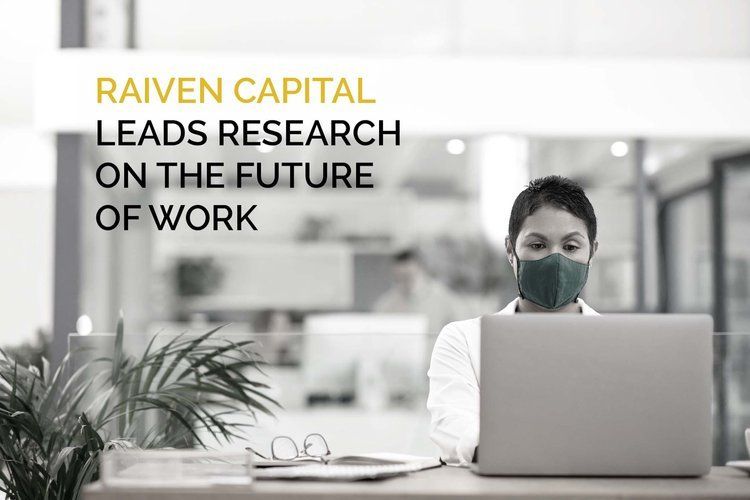
Raiven Leads Research on the Future of Work
Raiven Leads Research on the Future of Work...
Oatly Co-Founder Invests In Raiven Capital
In the past decade, transformative technologies—AI, IoT, 6G, and data analytics—have evolved from futuristic buzzwords into indispensable tools shaping industries worldwide.

A World of Innovation Awaits
An explosion of technology and innovation startups is happening around the world. But what is the best way to find the right ones and nurture them to exit?